Frontier Regulars by Robert M. Utley
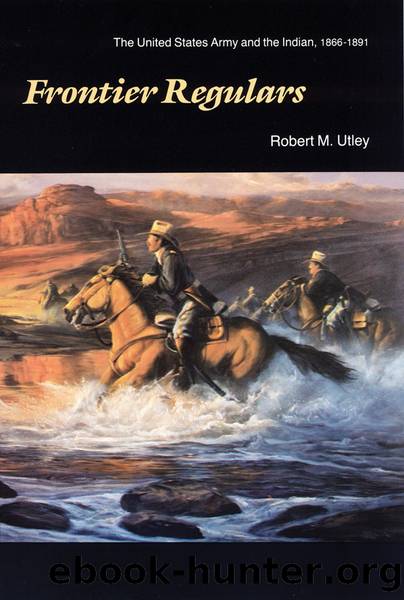
Author:Robert M. Utley [Utley, Robert M.]
Language: eng
Format: epub
ISBN: 978-0-8032-9568-1
Publisher: UNP - Bison Books
Published: 2014-07-14T16:00:00+00:00
NOTES
1. The Fitz John Porter case, at last resolved in Porter’s favor in 1886, heavily influenced the army’s internal politics, command relationships, and high-level promotions for two decades. The Sherman Papers, LC, abundantly document this judgment. A history of the controversy is Otto Eisenschiml, The Celebrated Case of Fitz John Porter (Indianapolis and New York, 1950). For Pope’s handling of the Red River operations, see Ellis, General Pope and U.S. Indian Policy, chaps. 9—10.
2. There is no satisfactory biography of Miles. Virginia Johnson, The Unregimented General: A Biography of Nelson A. Miles (Boston, 1962), is uncritical though valuable because it contains many extracts from Miles’ voluminous correspondence. Miles wrote two autobiographies: Personal Recollections and Observations (Chicago, 1896); and Serving the Republic (New York, 1911).
3. Taylor, ed., The Indian Campaign on the Staked Plains, pp. 14–16.
4. Carter, On the Border with Mackenzie, pp. 474—78. Ernest Wallace, ed., Ranald S. Mackenzie’s Official Correspondence Relating to Texas, 1871–1879 (Lubbock, Tex., 1968), chap. 2.
5. Pratt, Battlefield and Classroom, p. 6.
6. The best account of this affair is Nye, Carbine and Lance, pp. 206–10. See also Army and Navy Journal, 12 (Aug. 29, 1874), 38; (Sept. 5, 1874), 56.
7. Main sources for Miles’ operations are Personal Recollections and Observations, chap. 11; Johnson chaps. 4—5; Baird, “General Miles’s Indian Campaigns,” pp. 351–53; and official reports in Taylor, ed., passim, but especially Miles to Asst. Adj. Gen. Dept. Mo., March 4, 1875, PP. 197–216. Army and Navy Journal, 12 (Oct. 31, 1874), 186–87. Robert C. Carriker, ed., “Thompson McFadden’s Diary of an Indian Campaign, 1874,” Southwestern Historical Quarterly, 75 (1971), 198–232.
8. Price’s operations in the first phase of the campaign are covered in detail in Price to Williams, Sept. 23, 1874, in Taylor, ed., pp. 46–55.
9. Davidson to Asst. Adj. Gen. Dept. Tex., Oct. 10, 1874, in Taylor, ed., pp. 69–73. Davidson had six troops of the Tenth Cavalry and three companies of the Eleventh Infantry, together with forty-four Tonkawa scouts under Lt. Richard H. Pratt and a section of howitzers. Buell commanded four troops of the Ninth Cavalry and two of the Tenth. Two companies of the Eleventh Infantry guarded his train. Buell counted about 300, Davidson about 400 officers and men. For the organization of Davidson’s command, see Army and Navy Journal, 12 (Sept. 19, 1874), 85.
10. Known as “Anderson’s Fort” in honor of the infantry commander Maj. Thomas M. Anderson, the supply base was on the site of Mackenzie’s base camp in 1872. The Freshwater Fork of the Brazos is also known as Catfish Creek and White River.
11. Mackenzie was notorious for the infrequency and brevity of his official reports. Private correspondence is almost nonexistent. Most accounts of this expedition rest on Carter. See also Wallace, Ranald S. Mackenzie on the Texas Frontier, chap. 8; Wallace, ed., Ranald S. Mackenzie’s Correspondence Relating to Texas, 1873–1879, chap. 2; Nye, Carbine and Lance, pp. 221—25; and Haley, Fort Concho and the Texas Frontier, pp. 213–26.
12. Buell’s movements are detailed in Leckie, The Buffalo Soldiers, pp. 125–30. See also documents in Taylor, ed.
Download
This site does not store any files on its server. We only index and link to content provided by other sites. Please contact the content providers to delete copyright contents if any and email us, we'll remove relevant links or contents immediately.
| Africa | Americas |
| Arctic & Antarctica | Asia |
| Australia & Oceania | Europe |
| Middle East | Russia |
| United States | World |
| Ancient Civilizations | Military |
| Historical Study & Educational Resources |
In Cold Blood by Truman Capote(3422)
The Innovators: How a Group of Hackers, Geniuses, and Geeks Created the Digital Revolution by Walter Isaacson(3393)
Steve Jobs by Walter Isaacson(2936)
All the President's Men by Carl Bernstein & Bob Woodward(2396)
Lonely Planet New York City by Lonely Planet(2247)
And the Band Played On by Randy Shilts(2238)
The Room Where It Happened by John Bolton;(2186)
The Poisoner's Handbook by Deborah Blum(2171)
The Innovators by Walter Isaacson(2137)
Being George Washington by Beck Glenn(2130)
The Murder of Marilyn Monroe by Jay Margolis(2128)
Lincoln by David Herbert Donald(2017)
A Colony in a Nation by Chris Hayes(1956)
Under the Banner of Heaven: A Story of Violent Faith by Jon Krakauer(1829)
Amelia Earhart by Doris L. Rich(1714)
Dirt by Bill Buford(1713)
The Unsettlers by Mark Sundeen(1712)
Zeitoun by Dave Eggers(1689)
Birdmen by Lawrence Goldstone(1683)
